Conclusion
An old Apache saying says that one can take many paths to the same place. This is also true across the entire terrain of human studies. There are no disciplines in the universe, only concepts. Oftentimes, two separate fields uncover the same fundamental idea, just differently. Fundamental truths are falsifiable meaning that there exists the possibility of finding evidence that either supports or refutes. We begin in this perplexing forest, and we are lost amidst the arbor. At least start walking to find a way. A way may exist, and you may stumble upon the trail. Or, however, you may unknowingly discover an alternative way that does not have a trail. This is the definition of a trailblazer. Maybe there is a path: take it. Maybe there is a path less taken: take it. This is your journey, and you have the choice to navigate the forest. Be sure to stop and observe Nature, for She reveals ideas not communicable by an audible language. She speaks in voiceless hymns. Extraordinary claims require extraordinary evidence. Which is more likely: that nature should break its fixed course or that a man should lie? Study Her processes with childlike bewilderment. For example, the trees of the forest create the forest. However, do not lose the forest from the trees. Observation of a single tree does not tell the story of the forest.
Times are always changing and it is disappointing to see the level of humor today. It is sad to witness that although we are accelerating in the sciences, our humanities, which include real inspirational things like art, are deteriorating. Comedians from the past were not professionals, they were just themselves. The whole point about comedy is that all comedy is critical. Sadly, some people misinterpret criticism as cruelty. Be the change that you want to see in the world. What do you value? Where are you going? What path are you on: your own or others? The key to a good life is to focus only on what will matter in your final hour.
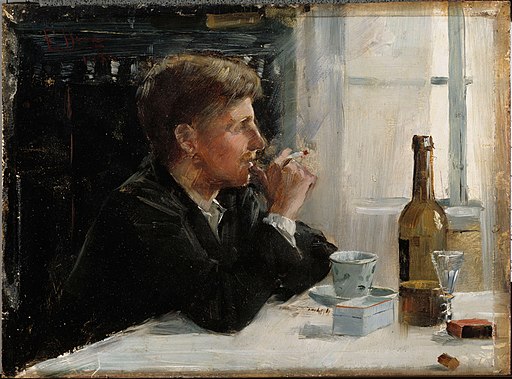
Elin Danielson-Gambogi, Seated Man at the Table, 1886. Oil on canvas.
To those who heed their education properly will receive an outcome consisting of tranquility, fearlessness, and freedom. We should not heed the many who claim that education is reserved for the free, but rather the philosophers who assert that only the educated are truly free. For enlightenment is not merely a matter of learning, but of unlearning. Cultivate the Stoic doctrine daily. There is a proverb that states how the habit alone does not make the monk. The Stoic habit must be acted upon, not merely thought about. Eliminate distractions to optimize your organization. Most importantly begin and continue to read and write. Wrestle with your ideas on paper since it has more patience than people. Writing about something teaches you about what you know, what you don’t know, and how to think. One cannot think without writing, just as reading makes a complete person, conversation makes a quick-witted one, and writing makes one precise.
Thinking means concentrating on one thing long enough to develop an idea about it. Begin exploring your thoughts and ideas through journaling. Writing is like sculpting with marble. We just have to create the block of marble first. Separate the processes of creation and improvement. You cannot write and edit, sculpt and polish, or make and analyze simultaneously. If you try, the editor stifles the creator. While you invent, don’t select. While you sketch, don’t scrutinize. While you write the first draft, don’t reflect. In the beginning, the creative mind must be free from judgment.
This is what good philosophers—and reasonable people in general—do: listen to each other’s arguments, reflect and learn, and then continue the discussion over drinks. Most problems are easily fixed. 90% of issues can be solved by good sleep, a glass of water, a gym session, a walk outdoors, or a chat with a friend. Action is an antidote to anxiety because action brings you to the present, but no amount of action will give us the sense of control we desire over life. We should shift the framing of depression from an imbalance of chemicals to an imbalance of unmet psychological needs. Lao Tzu warned to watch your thoughts, as they become your words. Watch your words, as they become your actions. Watch your actions, as they become your habits. Watch your habits, as they become your character. Watch your character, as it becomes your destiny. Retirement is when you find a sustainable way to fully live your life in the present moment, without sacrificing any of that time in exchange for future reward.
Life is like paddling a kayak down a river: to move forward, we must find balance, paddling on both sides with rhythm and intention. If we focus too much on one side, we spiral into circles, expending energy but getting nowhere. Progress is not just about movement; it’s about direction. Without purpose, we risk ending up like a rocking chair—busy but static, mistaking activity for growth. And sometimes, life feels less like a solo kayak and more like a canoe—where progress depends on many hands working in harmony, each paddle stroke coordinated toward a shared destination. Yet, like the Lady of Shalott drifting toward Camelot, even when we take action and leave the safe confines of our routines, we may face uncertainty or risk; the journey itself, with all its tension between caution and curiosity, is where meaning and beauty emerge.
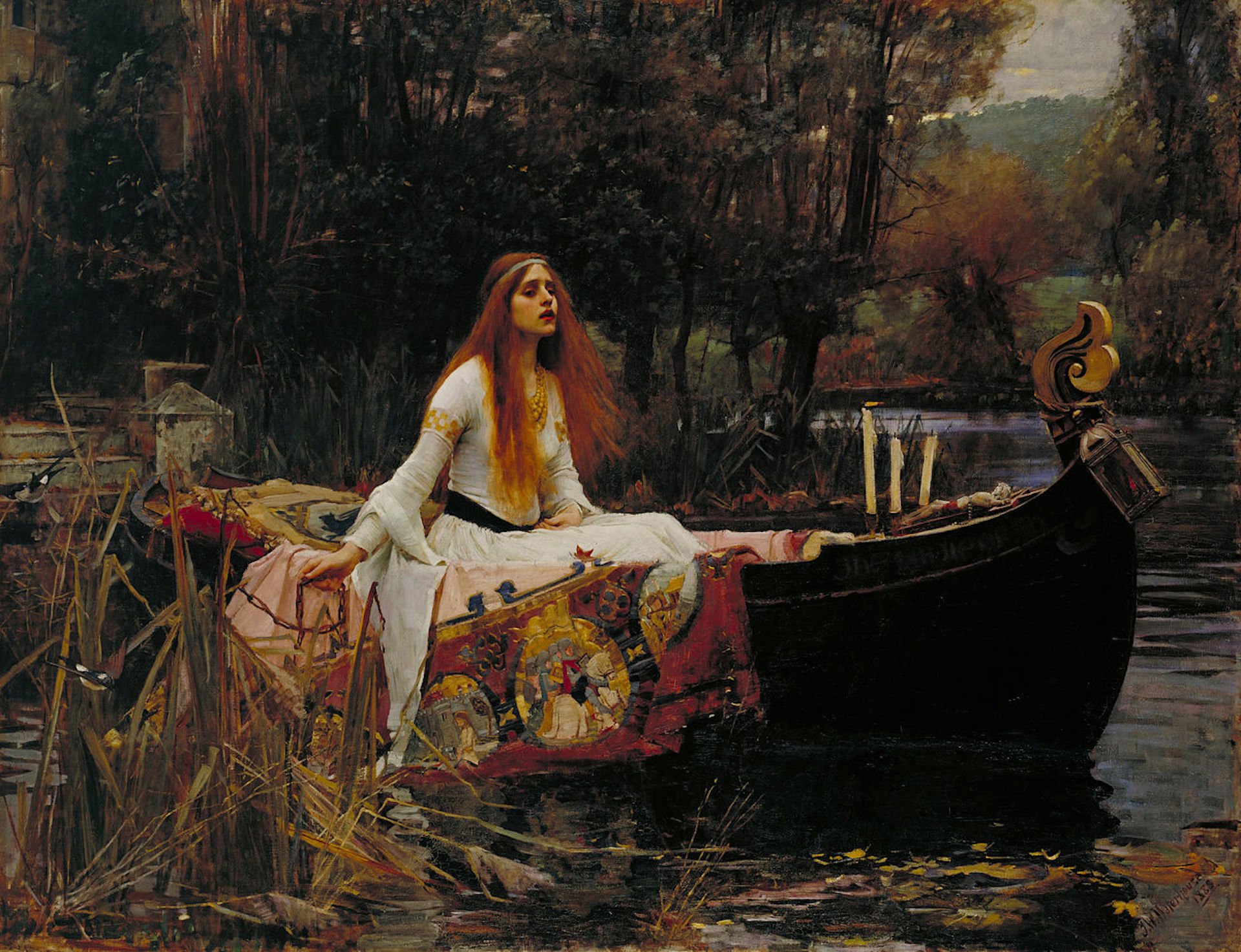
John William Waterhouse, The Lady of Shalott, 1888. Oil on canvas.
Time, like the river, is constantly flowing. As Leonardo da Vinci said, “The water that you touch is the last of what has passed and the first of that which comes; so with present time.” Each moment is fleeting, a bridge between what was and what could be, reminding us to paddle with care. When we feel lost, overwhelmed by the complexity of life—when the books become trees once again and we find ourselves blind in a forest—we must start finding our way by walking. Yet walking aimlessly won’t do; we must see both the forest and the trees, the big picture and the details. Don’t waste time pulling petals, agonizing over minutiae. Cut off the head; ask the real question: what’s truly happening here? What truly matters?
Let go of the distractions, the noise, and even your cherished assumptions. Be bold enough to confront the root of things. Embrace the wisdom of nullius in verba—take nobody’s word for it—and be willing to question, adapt, and even kill your darlings when necessary. Life demands not just effort but clarity and courage. To paddle forward is to balance intention with curiosity, motion with mindfulness, and action with reflection. In the end, every moment, like every stroke of the paddle, is an opportunity to recalibrate, to align with purpose, and to move closer to where you want to be.
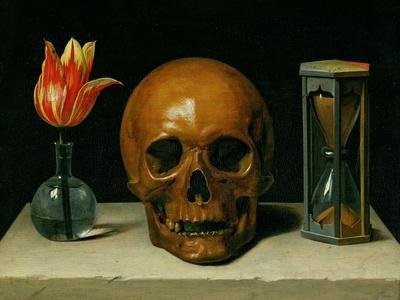
Philippe de Champaigne, Still Life with a Skull, c. 1671. Oil on panel.
This meditation on impermanence unites the three great symbols of existence: the flower, representing the fragile beauty of life; the skull, the inevitability of death; and the hourglass, the silent witness of time’s passing. Together they remind us that all things bloom, decay, and return—yet meaning emerges only through awareness of this cycle.
In the spirit of Katâlepsāra, this image captures the art of grasping truth amid transience: to hold knowledge firmly, yet gently enough to let it evolve. Just as the flower fades and the sand falls, wisdom is not amassed but digested—an ongoing transformation of perception into understanding within the ever-turning wheel of existence.
We are mortal yet alive, social yet solitary, free yet constrained, purposeful yet surrounded by absurdity.
Greening’s four existential dialectics—life and death, community and isolation, freedom and determinism, meaning and absurdity—outline the paradoxes that shape the human condition. These tensions echo the relationship between katâlepsis, the grasp for certainty, and saṃsāra, the flux of continual change. Katâlepsāra emerges as the practice of living within this dynamic equilibrium: holding truth firmly enough to act, yet lightly enough to adapt. It is not the elimination of contradiction, but the art of balance; the art of navigating existence with both conviction and humility.
This same rhythm animates life at the molecular level. In cellular respiration, vitality depends on the ceaseless interplay of oxidation and reduction, where decay and synthesis are not opposites but mutually sustaining forces. Energy is conserved through transformation; the byproducts of one reaction become the substrates of the next.
So too in the life of the mind. Katâlepsāra envisions an epistemic metabolism: the oxidation of obsolete ideas and rigid certainties fuels the reduction and refinement of understanding into wisdom. To live wisely is to remain in this perpetual cycle of transformation, digesting new knowledge, releasing what no longer serves, and maintaining intellectual and spiritual equilibrium through constant change. Meaning is not discovered in finality but cultivated through this graceful, ongoing dance between grasp and release—between the search for certainty and the acceptance of impermanence.