28 min to read
Consciousness
🧠 Five layers—from feeling, to prediction, to the living system that makes a point of view possible.

What is consciousness?
I have been collecting notes around that question since 2019. The collection grew much faster than my understanding. Philosophy led me to psychology; psychology led to neuroscience; neuroscience sent me back to philosophy. A question about pain became a question about expectation. A question about memory became a question about time. A question about sheep became a question about whether behavior can ever tell us what another creature feels.
Eventually, the size of the project became an excuse not to write it.
The problem is that consciousness will not hold still. Is it wakefulness? Attention? Intelligence? Self-awareness? Memory? The ability to feel pain? The capacity to report an experience? Is it what the brain does, or what all that activity feels like from the inside?
I do not have one final theory that dissolves those questions. What I have is a way of arranging them. This essay moves through five levels, each useful on its own and each complicating the last:
- consciousness as experience
- consciousness as embodied perception
- consciousness as prediction, memory, and action
- consciousness as organized biological activity
- consciousness as the explanatory gap that remains
My goal is a clear, reductionist description of organic consciousness. By reductionist, I do not mean that a person is “nothing but neurons.” I mean that I want an account whose parts can eventually be connected to physical processes. Neurons will sometimes stand in as shorthand, but they are not alone: glia, hormones, blood flow, organs, development, relationships, and environments all participate in the activity we are trying to explain.
Nor does explaining the machinery explain away the life lived through it. That tension is the point.
Level One: I feel, therefore I am
The cleanest definition I have found is also the least ambitious:
Consciousness is the presence of subjective experience.
If there is something it is like to see red, taste coffee, feel grief, hear a cello, dread tomorrow, or dream without knowing you are dreaming, consciousness is present. Life is not merely happening. It is happening for someone.
Descartes gave us cogito ergo sum: I think, therefore I am. But what counts as thinking? Must it involve language, reflection, or a concept of oneself? I find sentio ergo sum easier to hold onto: I feel, therefore I am. Feeling does not settle what consciousness is made of, but it identifies what any theory has to explain.
This definition separates ideas that are often treated as synonyms.
Consciousness is not wakefulness. A person may be awake yet minimally aware, or asleep and immersed in a vivid dream.
Consciousness is not attention. Attention selects. Experience exceeds that selection. The hum of a room can be present without occupying the center of thought.
Consciousness is not intelligence. Intelligence concerns what a system can do—plan, solve, optimize, speak. Consciousness concerns whether there is anything it is like to be that system.
Consciousness is not self-consciousness. The self can loosen in flow, meditation, absorption, or psychedelic states while experience remains intense. Books and films can quiet the ego for a similar reason: for a while, I am transported out of the project of maintaining me and into the simulated life of someone else.
And consciousness is not behavior. Behavior is evidence, sometimes the only evidence available, but it is not the thing itself. In a large 2024 study, about one quarter of behaviorally unresponsive patients showed task-related activity on EEG or fMRI. The finding is called cognitive motor dissociation. It makes the distinction brutally practical: inability to act is not proof of inability to experience.
The sheep problem
I first felt the force of this problem while working as a caretaker at CHOP.
The sheep almost never “bahhed” while I cleaned. I could hose for an hour and a half. I could drop a platform grate with a piercing clang. They might move away when I entered their run, gathering together in the adjoining space, but they rarely vocalized.
The dependable exception was transport. Separate one sheep from the group and the vocalizing began.
My first interpretation was immediate and human: they are hurt in the heart; they are missing their friend. That may be right. It may also be anthropomorphic. Prey animals can conceal vulnerability, vocalization can serve several social functions, and the same outward behavior can be produced by different inner states.
But that uncertainty does not make the observation worthless. It tells us what the science of other minds is like. We look for patterns across context, physiology, behavior, and time. We ask whether the response is consistent, distinctive, and shared. We behave like intuitive scientists while never possessing the other creature’s point of view.
So the first level gives me a definition and a limit: consciousness is experience, but experience is private. Everything else is inference.
Level Two: A point of view has a body
The traditional “mind–body problem” is too narrow for me. I think the better phrase is the world–brain–body problem.
A brain does not float in a jar. It occupies a body that has to keep temperature, oxygen, thirst, hunger, balance, pain, and energy within survivable ranges. That body moves through an environment that is never fully predictable. The world changes the body; the body changes the brain; the brain changes behavior; behavior changes the world that supplies the next round of signals.
This is not a straight line from stimulus to response. It is a loop.
That loop also changes how I think about “survival of the fittest.” Fitness is not a little substance an organism possesses. A better question is: what environmental and bodily forces make this behavior more likely in this context? The same organism can look brave, fearful, attentive, or indifferent under different constraints. Environment and experience are not the same. Two people can occupy the same room and inhabit very different worlds.
Perception is an interpretation
Try this. Cross your index and middle fingers. Close your eyes and touch one rounded object—the tip of your nose or a pen cap—to the crossed fingertips. Many people feel two objects.
This is Aristotle’s illusion. The stimulus has not doubled. The nervous system is interpreting an unfamiliar arrangement through the statistics of familiar touch. Two skin surfaces that do not normally meet one object at the same time are treated as evidence for two objects.
The illusion is not merely a failure. It reveals the rule the system was using.
Perception, then, is not a camera. Sensory organs provide partial and noisy signals. The brain combines those signals with bodily state, prior experience, and expectations to infer what is most likely causing them. This is why perception is sometimes called a controlled hallucination. Reality is not imaginary; experience is a constrained best guess about a reality available only through signals.
Colin McGinn’s discussion of seeming helped me sharpen this. A perception can make something seem real without becoming a belief. I can know that two lines are equal while one still looks longer. Seeming is an invitation to belief, not belief itself. Consciousness lives in that curious interval: reality makes an impression on us, and then we have to decide what the impression means.
The body edits the world
Interoception is the sensing of the body’s internal condition: heartbeat, breath, visceral tension, warmth, nausea, fatigue, and much more. These signals are not decorative sensations attached to neutral thought. They help determine which parts of the world become salient and which actions become likely.
Consider thirst. In experiments by Henk Aarts and colleagues, participants made thirsty by salty candy became quicker to recognize drink-related words and later recalled more drink-related objects. Their need had quietly reorganized attention. A glass of water did not become objectively brighter; it became cognitively louder.
Pain works the same way. Nociception matters, but pain is not a number transmitted directly from tissue. Expectation, anxiety, sleep, attention, context, learning, and bodily state shape the experience. This does not make pain unreal. It makes pain a construction of a living regulatory system.
Even agency is built from this traffic. Whether a person feels internally directed, externally controlled, supported, or helpless alters which actions seem available. The diagram below is busier than the simple loop I am describing, but that busyness is instructive: motivation is not located in one isolated switch.
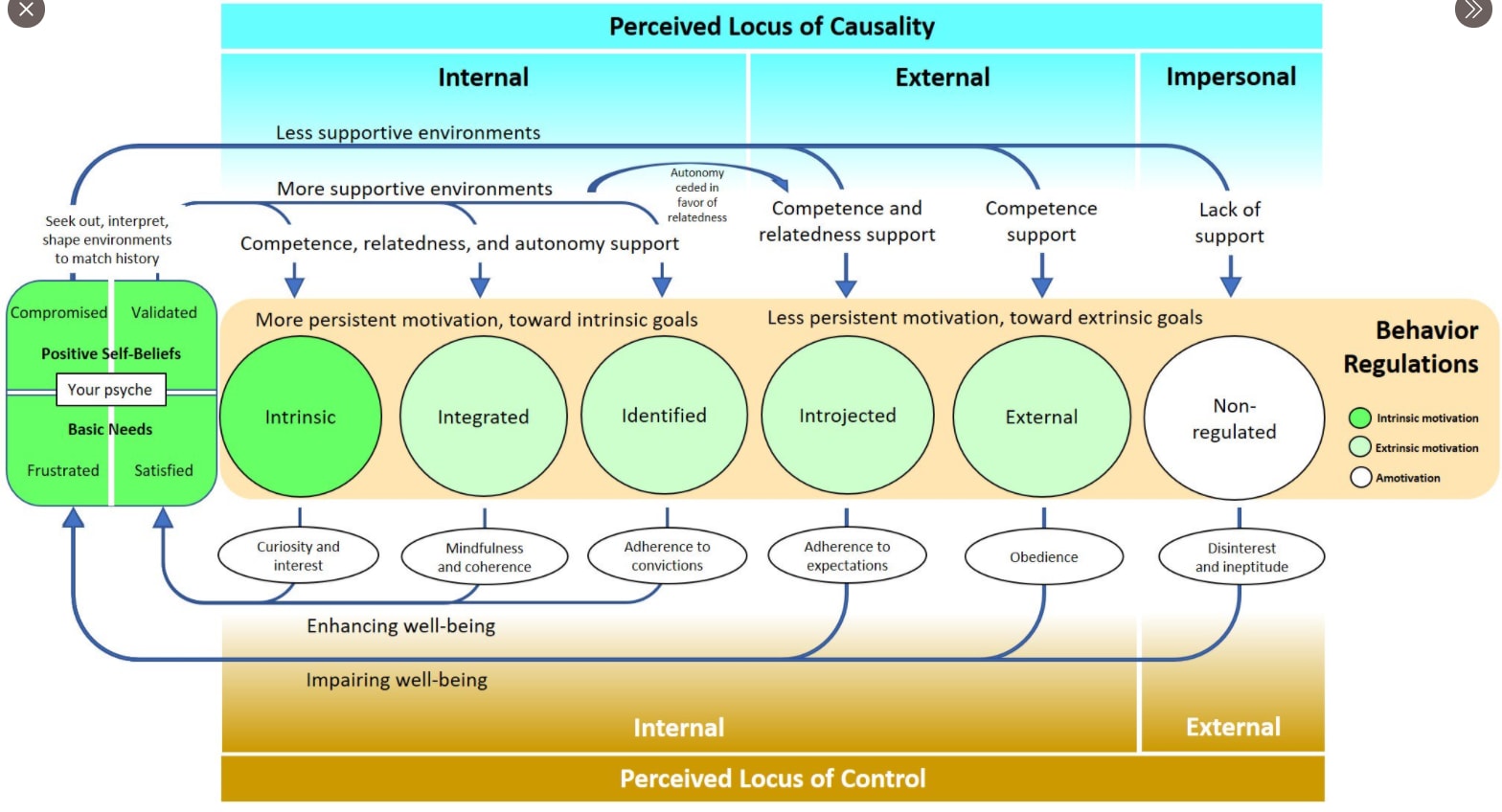
At this second level, consciousness becomes an embodied point of view continually negotiated among brain, body, and world.
Level Three: The present is built from the past
Lately, life has felt sped up. The last three years seem like a quick blur. My time at CHOP could feel drudging and slow while I lived it; looking back, it seems to have slipped past.
The usual answer is that time accelerates as we age. But what if the change is not in time itself? What if it is partly a change in how densely experience is stored?
Researchers distinguish experienced duration from remembered duration. While time is passing, attention matters. Looking backward, memory matters. The mind does not preserve a seamless recording; it segments life into events. Changes in place, goal, activity, or expectation create event boundaries, which help organize attention and long-term memory. Work on event cognition gives a more precise form to my original hunch.
Maybe adulthood is not simply a loss of memory “capacity.” Repeated routines may create fewer distinctive boundaries and fewer retrieval cues. A month full of novelty leaves a dense structure. A month of similar days can be compressed into one summary. The days were lived in full; the later archive is sparse.
That is still a hypothesis, not a universal law. But it connects the subjective acceleration of life to the same machinery that constructs the present: memory, attention, novelty, and prediction.
Prediction error: the surprise that gets through
The world arrives faster than deliberation. To act in time, the nervous system anticipates.
Predictive-processing theories describe a hierarchy of models. Higher levels generate expectations about the causes of sensory input; incoming data expose mismatches; the system updates the model or acts to change the input. In a compact phrase from my notes: output comes first. The brain maps not only the world as it is, but the world as it is about to unfold under the pressure of our own actions.
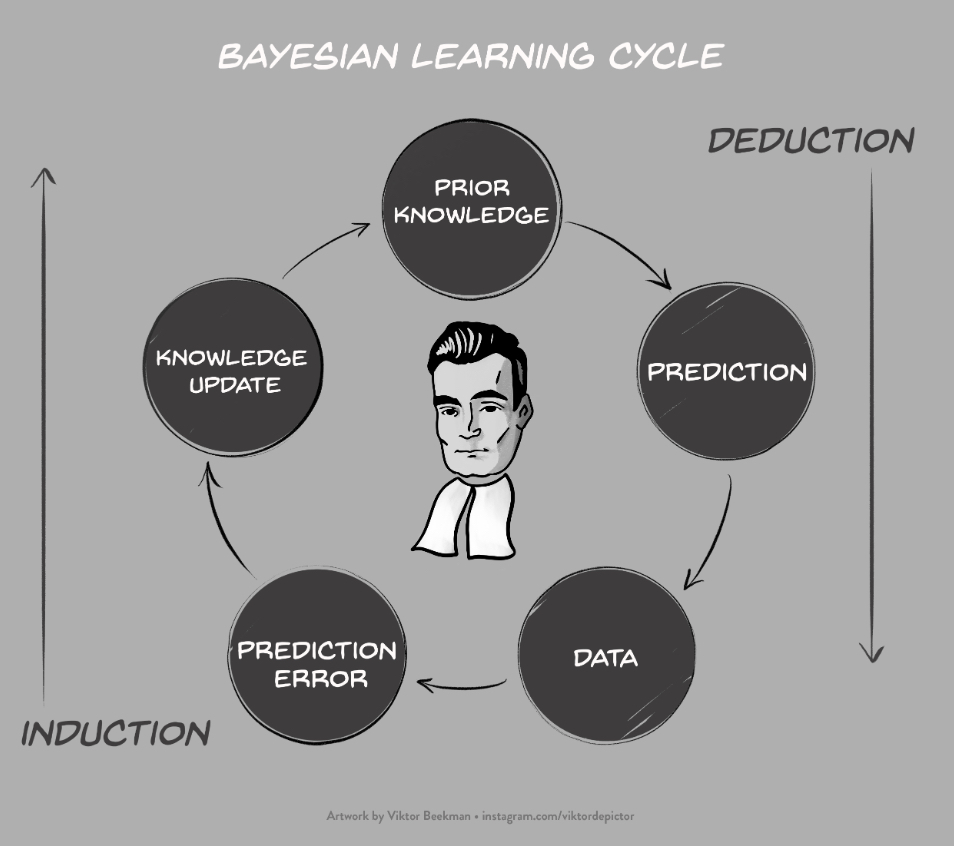
A prediction error is more than generic surprise. A rule existed in the system, and the event violated it. That violation can redirect attention and drive learning. The Rescorla–Wagner model made prediction error central to associative learning: learning is greatest not when an outcome merely occurs, but when the outcome differs from what was expected.
This unifies ideas that originally sat in separate corners of my outline:
- thirst raises the accessibility of goal-relevant cues;
- an illusion exposes a prior assumption;
- novelty draws a boundary around an event;
- learning updates expectations after error;
- habit allows expected detail to recede;
- attention determines which errors win access to limited processing.
“Experiences are competing for space in the brain” was one of my earliest summaries. Space is metaphorical, but the competition is real. Salience, need, reward history, surprise, and present goals help determine what survives the filter.
Learning also requires forgetting
Memory is not a warehouse behind consciousness. It supplies consciousness with its structure. It lets a sensation become familiar, a face become a person, and a sequence become a story. A system cannot recognize a mismatch unless it has retained a pattern.
But remembering everything would not necessarily be wisdom. Forgetting abstracts, clears interference, and makes later retrieval effortful. That effort can strengthen learning. Spacing, context changes, and interleaving work partly because they allow some forgetting and force reconstruction rather than immediate repetition.
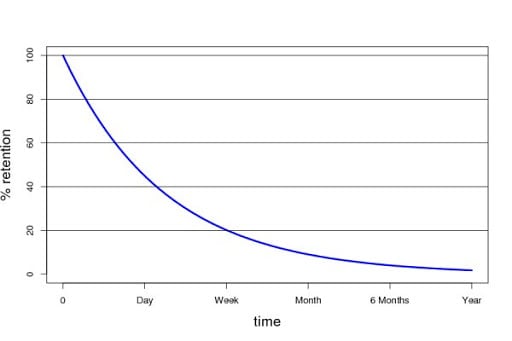
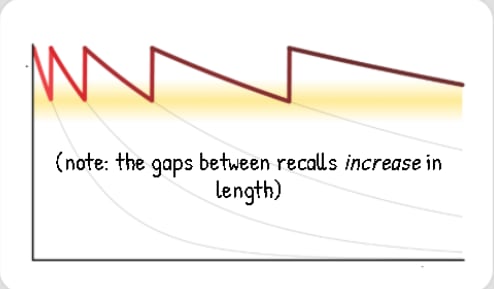
This has changed a small part of my routine. After a Pomodoro or a training bout, the impulse is to pick up my phone and pour new input into the gap. I am trying something else: five or ten quiet minutes, eyes closed, letting the system replay what it just did. The pause is not empty. It may be part of the learning.
The same principle may explain why an answer sometimes arrives only after I stop forcing it. Work loads the problem; rest allows it to percolate. Conscious effort begins the search but does not own the whole process.
Action teaches the system what belongs to it
Every movement produces sensation. Eyes sweep; feet strike the floor; a voice returns through the ears. If all of that were processed as an unexpected external event, perception would be chaos.
Through corollary discharge, motor-related signals prepare sensory systems for the expected consequences of an action. An efference copy can cancel or reduce predictable self-generated input; corollary discharge is the broader family of motor-related signals that can inhibit, facilitate, or modulate sensory processing. This is one reason we cannot tickle ourselves as effectively as someone else can.
The mechanism is not itself a theory of consciousness. It is a concrete example of how a self can be distilled from patterns. Across countless comparisons, the system learns a practical boundary between self-caused and world-caused change. When that attribution becomes unstable, ownership of a thought, voice, limb, or action can become unstable with it.
We are intuitive scientists—and sometimes intuitive lawyers
I have often thought that I am good at predicting how people will behave. A less flattering and more useful interpretation is that I have spent years informally tracking covariation: does this behavior remain consistent over time, is it distinctive to this situation, and is there consensus across people?
Harold Kelley’s covariation model turns that habit into a diagram.
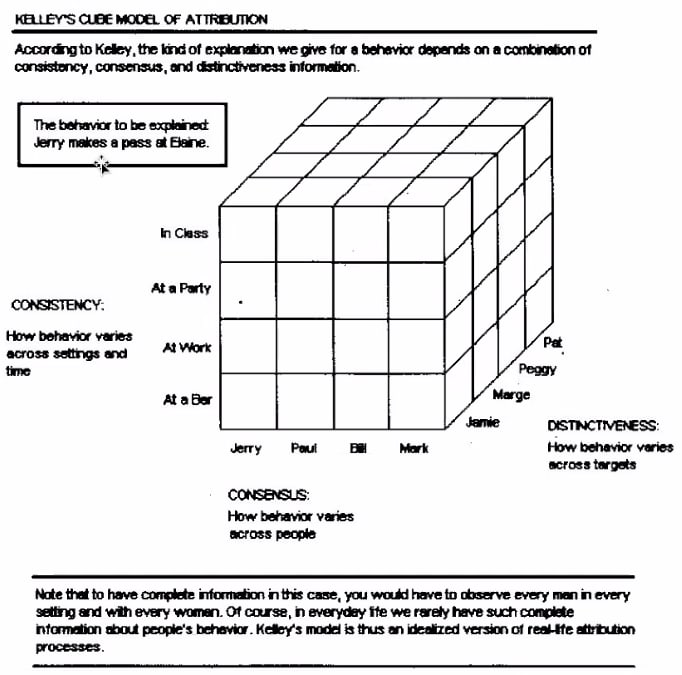
The trouble is that real life never gives us every cell in the cube. We rarely have enough observations, our samples are biased, and our prior relationships color what we notice. Worse, we are not always naïve scientists searching for cause. Sometimes we are naïve lawyers searching for blame.
This is where prediction touches psychoanalysis, cognitive dissonance, and worry. A feeling can exist without its correct explanation. If the source of an emotion is unavailable, the brain does not leave the feeling unlabeled; it constructs a plausible story. Certainty can be rewarding because it closes an unresolved loop. Doubt keeps alternatives alive, which is useful for truth and uncomfortable for the organism.

At level three, consciousness is an embodied model extended through time—using memory to predict, attention to select, action to test, and error to revise.
Level Four: A living organization, not a magic cell
What is the brain doing when experience is present?
The honest answer is that neuroscience has important constraints and correlates, not a universally accepted mechanism. There is no single consciousness neuron and no scan that settles every possible case.
It is still possible to say something more precise than “the whole brain does it.”
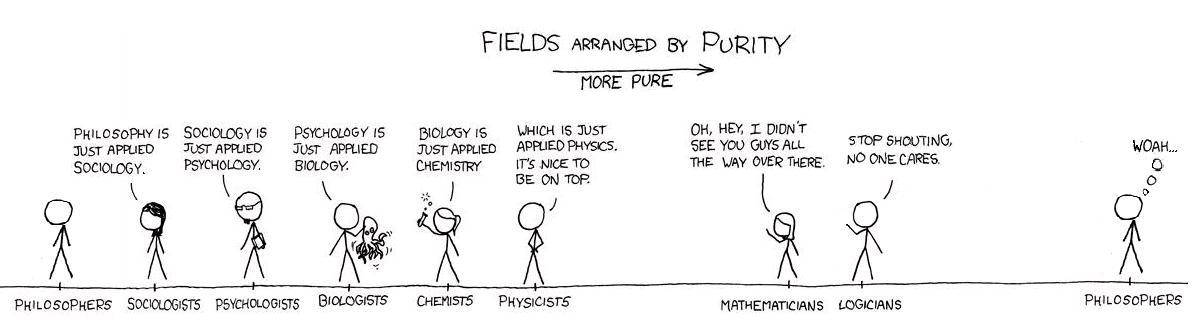
“Purity,” xkcd #435 by Randall Munroe.
The joke captures a temptation I want to resist. Moving from psychology to biology is not moving from a vague description to the “real” one; it is changing levels of description. A psychological pattern can be entirely physical without being usefully explained away as chemistry. Reduction, for me, should connect the layers rather than declare a winner.
Conditions are not contents
A functioning brainstem, circulation, metabolism, and arousal system are necessary for ordinary human consciousness. But the systems that keep the brain capable of experience are not identical to the activity that specifies this experience.
Electricity enables a film projector; it does not explain why the scene contains a red dress, a familiar face, or a frightening sound. In the same way, enabling systems maintain the conditions under which cortical and thalamic activity can support differentiated contents.
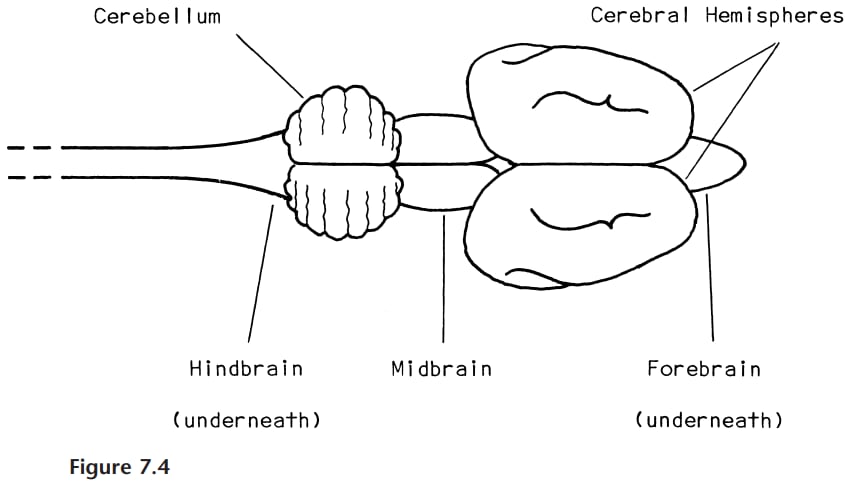
The growth of the mammalian cerebral hemispheres and cerebellum is one visible piece of this evolutionary story. More tissue is not automatically more consciousness, but expanded, recurrently connected association systems create more ways for sensation, memory, and action to constrain one another.
Differentiation and integration
A conscious scene is highly differentiated and highly integrated.
It is differentiated because this experience excludes countless alternatives: red is not blue, pain is not warmth, this face is not every face. It is integrated because color, shape, location, memory, emotion, and bodily response arrive together as one moment rather than unrelated calculations.
A system locked into uniform activity lacks differentiation. A system producing independent noise lacks integration. Conscious activity seems to require a rich middle ground: many possible states whose parts can still make a difference to one another.
The Perturbational Complexity Index (PCI) turns part of that intuition into a measurement. Researchers perturb cortex with transcranial magnetic stimulation and record the response with EEG. A local or stereotyped response has lower complexity; a differentiated, widely interacting response has higher complexity. In the original validation study, PCI separated the sampled conscious and unconscious conditions with a cutoff near 0.31.
That number is not a metaphysical border engraved into nature. It belongs to a particular method and set of observations. Its importance is conceptual as well as clinical: we may be able to estimate consciousness without requiring a person to speak, move, or understand a command.
The brain is never waiting for the world
The old stimulus–response picture makes the brain seem passive: input arrives, processing happens, output follows. But even at rest the brain generates structured spontaneous activity shaped by physiology and history.
My own working hypothesis is that conscious life emerges partly through the negotiation of two streams:
- externally driven activity, organized around current sensory events;
- spontaneous activity, arising from the system’s ongoing internal dynamics.
Too much external capture and the organism becomes purely reactive. Too much internally generated activity and the model drifts away from present constraints. Consciousness may live in the settlement between them.
I have sometimes described this as two Rescorla–Wagner-like processes competing for an equilibrium: one updating the organism from outside, the other projecting the organism from within. I do not mean that the original learning equation already explains consciousness. I mean that error-correction may be a useful common grammar for the traffic in both directions.
The mind is forever internalizing and externalizing, not merely being stimulated and responding. Perception internalizes the world; language and action externalize a model; the consequences return as new perception. Writing externalizes memory. Conversation externalizes thought. A life is built through repeated passes around that loop.
How could a pattern become meaning?
The famous “Jennifer Aniston cell” is easy to sensationalize. In recordings from people undergoing epilepsy monitoring, particular medial temporal-lobe neurons responded selectively to images and even written or spoken names of a familiar person or concept. This is not evidence that one neuron contains Jennifer Aniston—or that a single cell is conscious. It shows how far sensory variation can be distilled into abstract, personally meaningful representations.
That matters because “understanding” may be less like possessing a fact and more like having enough surrounding associations for the fact to take a place. Lower-order input–output relations can become part of a larger mosaic. The more modalities, memories, needs, and possible actions a pattern can recruit, the more it can mean for the system.
Several theories attempt to explain which organizations matter:
Global Neuronal Workspace Theory says information becomes conscious when it is made globally available to otherwise specialized systems.
Integrated Information Theory begins with the differentiation and unity of experience and asks what physical causal organization could possess analogous properties.
Recurrent Processing Theory emphasizes feedback within and among sensory areas rather than a single forward sweep.
Higher-Order theories propose that a state becomes conscious when the system represents itself as being in that state.
These theories make different predictions. In 2025, a large preregistered adversarial collaboration tested claims from Global Neuronal Workspace Theory and Integrated Information Theory using fMRI, MEG, and intracranial recordings. Some predictions were supported and important parts of both theories were challenged. There was no simple winner—and that is progress. A science becomes sharper when its theories risk being wrong.
My provisional position
My current conviction is a form of embodied functionalism grounded in physicalism:
Organic consciousness is an activity of a sufficiently complex living system that integrates bodily and environmental signals, distinguishes self-caused from world-caused change, retains patterns across time, predicts what comes next, and makes selected information available to guide the organism as a whole.
This is close to saying that consciousness is what an appropriately organized brain–body system does. It does not mean the brain acts alone. Nor does it mean causation only travels upward from neurons to mind. Experience changes neurons; relationships change bodies; bodies alter what can be experienced. The loop has top-down and bottom-up descriptions without requiring an immaterial substance.
But this account leaves its hardest step exposed. Explaining discrimination, integration, memory, and action does not automatically explain why any of it feels like something.
Level Five: Knowing everything except what it is like
Suppose neuroscience eventually describes every causal transition involved when someone sees red. We know which receptors respond, which pathways carry the signal, which predictions change, which networks interact, what the person says, and what the person remembers.
Have we explained the redness of red?
This is the explanatory gap: the distance between a third-person description of function and the first-person fact of feeling. It may reflect unfinished science, limitations in our concepts, limitations in the human mind, or something fundamental about reality. I do not know which.
Mary leaves the room
Frank Jackson’s thought experiment makes the gap vivid. Mary is a scientist who knows every physical fact about color vision but has lived in a black-and-white room. When she sees red for the first time, does she learn something new?
If she does, complete physical knowledge appears not to contain experiential knowledge. If she does not, we still have to explain why acquaintance with red seems like discovery.
My physicalism survives Mary’s room, but not untouched. I am persuaded that consciousness has a material existence arising from an organized living system. I am not persuaded that a description of the system is interchangeable with being the system. A map can be complete as a map without becoming the terrain.
That is why I find sentio ergo sum more useful than a declaration that matter has made feeling disappear. Reduction should connect levels of explanation, not cancel the phenomenon at the level we began with.
The feeling of knowing is not knowing
After all of this reading, Robert Burton’s work on certainty rerouted me toward mysticism.
Consider the classic “kite” demonstration. An ambiguous paragraph initially feels meaningless. Then someone supplies one organizing word—kite—and the whole thing snaps into place. The sentences have not changed. A schema has rearranged them. Along with the interpretation comes an unmistakable feeling: now I know.
But the feeling and the truth can come apart.
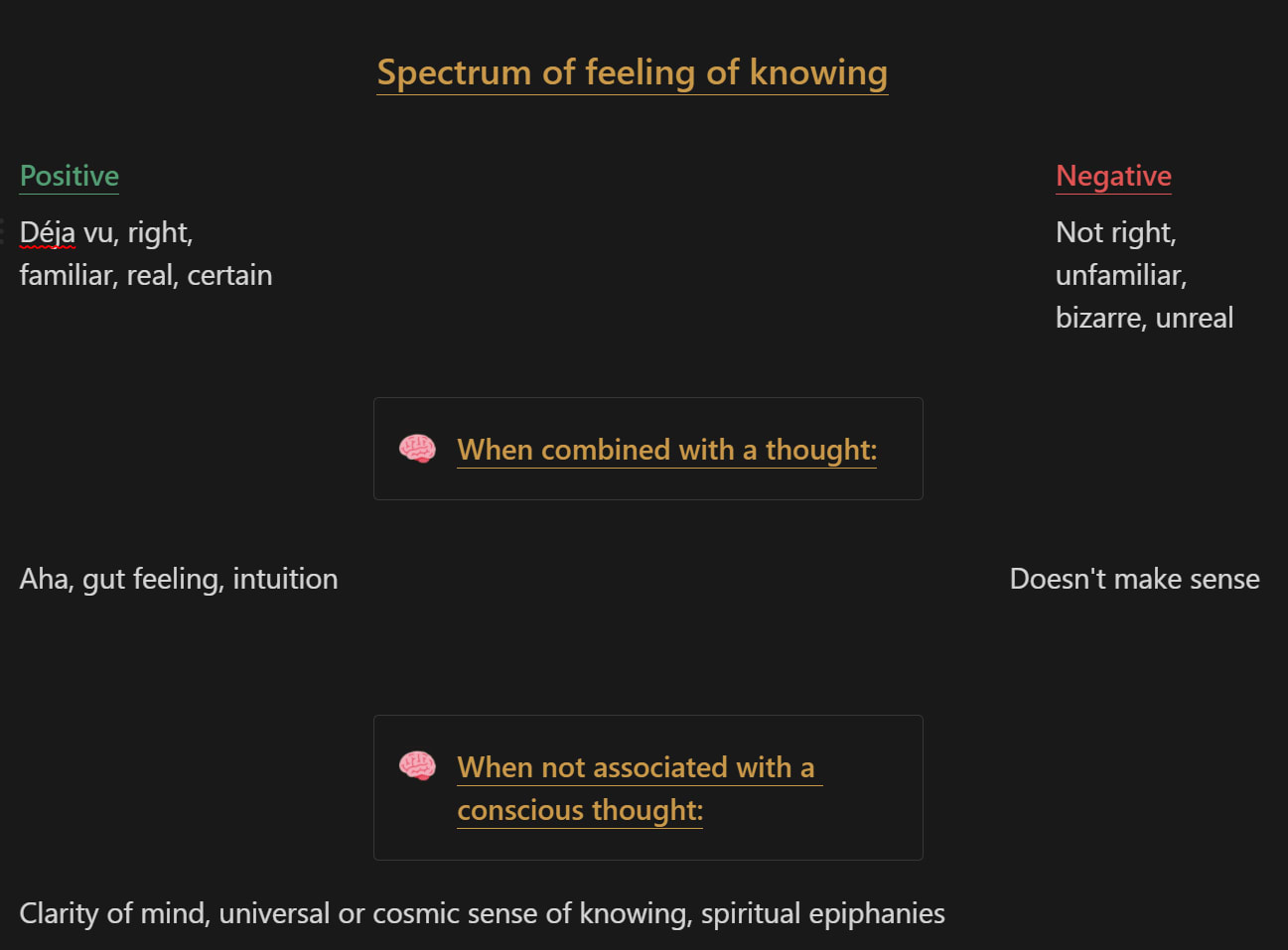
William James wrote about forms of “felt knowledge.” Al-Ghazali described mystical knowledge beyond ordinary knowledge, as if the senses themselves were shackles. Freud, in a very different register, worried about belief shaped by instinctual desire. I find the tension among them more useful than choosing one voice too quickly.
A feeling of knowing can accompany insight: scattered facts are reorganized into a better model. It can also accompany confabulation. A perception can seem true; an emotion can demand an explanation; a belief can reduce uncertainty; none of those facts guarantees that the explanation is right.
Psychedelic and mystical states intensify the problem. People report loss of self, altered time, unity, terror, ecstasy, revelation, and certainty that cannot be translated into propositions. These states matter because they reveal that time, selfhood, and ordinary world-modeling are modifiable while experience continues. Loosening high-level expectations may allow previously rejected interpretations to become salient.
But intensity is not verification. Feeling more real than reality does not make a metaphysical claim true.
This is where I want curiosity paired with epistemic restraint. Cynicism rejects possibilities before investigation. Credulity treats every possibility as a fact. The useful position is disciplined openness: let experience generate questions; let evidence discipline the answers.
Feeling of knowing ≠ knowing.
Physicalism, functionalism, idealism, illusionism
Physicalism holds that consciousness arises from physical processes. It is where I begin because it connects claims to evidence and mechanisms to tests.
Functionalism identifies mental states by the roles they play—their relationships to input, other internal states, memory, and action. It leaves open whether the same organization could be realized in a different material.
Idealism treats the mental or phenomenal as basic rather than derivative. It takes consciousness seriously, but inherits its own task: explaining why experience exhibits the stable, public regularities described by physics.
Illusionism argues that our intuitive picture of private phenomenal properties is mistaken. I am not convinced that calling consciousness an illusion makes it disappear. An illusion is still something experienced. But illusionism gives a useful warning: introspection may misdescribe the machinery that produces introspection.
I suspect Colin McGinn may be right about at least one possibility: a mind can be physically capable of posing a question it is not cognitively equipped to solve. As the island of knowledge grows, so does the shoreline of ignorance. The history of this subject should make certainty feel suspicious.
Could artificial intelligence be conscious?
AI is the next phase in a long trajectory of cognitive externalization. Writing externalized memory. Libraries and the internet externalized access to knowledge. AI is externalizing parts of cognitive computation: summarizing, comparing, transforming, predicting, and generating.
None of that by itself establishes experience.
The hot question is not simply whether a language model can produce the appearance of understanding. It is what understanding requires. If understanding is flexible use of information, current systems display meaningful forms of it. If it requires bodily action, autobiographical memory, needs, vulnerability, and a persistent point of view, the case is much less clear.
Language models learn structure from the traces of human experience. They manipulate products of consciousness without obviously sharing the biological processes that produced them. Yet declaring any non-biological system forever unconscious would assume the answer in the opposite direction.
The responsible position is neither “it speaks, therefore it feels” nor “it is software, therefore it cannot.” We need theories that say which properties matter, measurements that do not depend entirely on self-report, and ethical rules capable of tolerating uncertainty.
AI exposes how often we treated behavior as a shortcut for experience.
Where the five levels leave me
The argument can now be compressed:
- There is experience.
- Experience belongs to an embodied point of view.
- That point of view is built through prediction, memory, attention, and action.
- Those functions depend on differentiated and integrated biological activity across brain, body, and environment.
- A complete account of function may still leave open why organized activity feels like anything from the inside.
This model helps explain why perception can be fooled, why bodily need alters attention, why agency depends on predicted sensory consequences, why remembered time can compress, why behavior can fail to reveal awareness, and why intelligence cannot simply be substituted for experience.
It does not solve the hard problem. It does not give us a perfect consciousness meter. It does not tell me exactly what a sheep feels during transport, when an artificial system might become conscious, or whether physicalism is the final metaphysical story.
That incompleteness is not a reason to stop. It is the reason I keep asking.
I began this project wanting a definition. What I have instead is a method: distinguish the questions; move between first-person experience and third-person evidence; test mechanisms where we can; label speculation honestly; remain willing to update.
Perhaps consciousness is not a thing hidden somewhere inside the skull. Perhaps it is the living activity of a system continually internalizing the world and externalizing itself—sensing, predicting, acting, remembering, and revising.
The world presses inward. The organism answers. Somewhere in that recursive exchange, there is something it is like to be.
Interrogo ergo cogito: I ask questions, therefore I think.
And beneath even that: I feel, therefore I am.
Sources and further reading
- Aarts, H., Dijksterhuis, A., & de Vries, P. (2001). On the psychology of drinking: Being thirsty and perceptually ready.
- Block, R. A., & Zakay, D. (1997). Prospective and retrospective duration judgments: A meta-analytic review.
- Bodien, Y. G., et al. (2024). Cognitive motor dissociation in disorders of consciousness.
- Carey, B. (2014). How We Learn: The Surprising Truth About When, Where, and Why It Happens.
- Casali, A. G., et al. (2013). A theoretically based index of consciousness independent of sensory processing and behavior.
- Cogitate Consortium, et al. (2025). Adversarial testing of global neuronal workspace and integrated information theories of consciousness.
- Crapse, T. B., & Sommer, M. A. (2008). Corollary discharge circuits in the primate brain.
- Jackson, F. (1982). Epiphenomenal qualia. The Philosophical Quarterly, 32(127), 127–136.
- Michael, M. T. (2020). Unconscious emotion and free-energy: A philosophical and neuroscientific exploration.
- Quian Quiroga, R., et al. (2005). Invariant visual representation by single neurons in the human brain.
- Radvansky, G. A., & Zacks, J. M. (2017). Event boundaries in memory and cognition.
- Rescorla, R. A., & Wagner, A. R. (1972). A theory of Pavlovian conditioning: Variations in the effectiveness of reinforcement and nonreinforcement.
- Seth, A. K., & Friston, K. J. (2016). Active interoceptive inference and the emotional brain.
- Tinazzi, M., et al. (2013). Aristotle’s illusion reveals interdigit functional somatosensory alterations in focal hand dystonia.